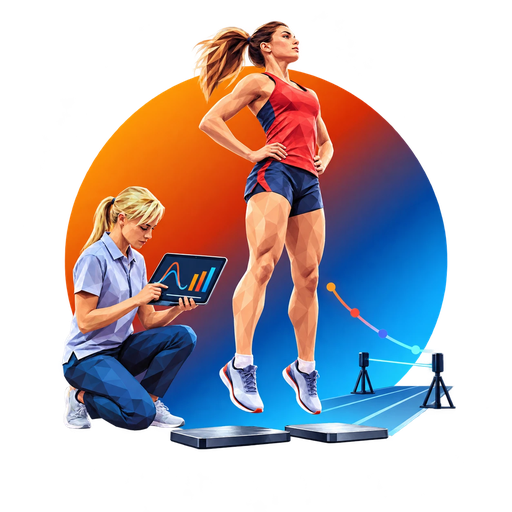
Measure jump height, force, power, reactive strength, asymmetry and sprint profiles from slow-motion video. No force plates and no timing gates: a phone camera and a tape measure.
In shortCoach Force Lab is a testing tool in the Athleet.Ai coach editions. A coach films a jump or a sprint in slow motion, marks take-off and landing frame by frame, and gets jump height, force, power, reactive strength, left and right asymmetry and a sprint force-velocity profile, with charts, the athlete's own baseline and a coaching report. The video stays on the coach's device.
Countermovement jump, squat jump, Abalakov jump, free-arms and loaded jumps, and single-leg jumps on each side.
Mean push-off force, velocity and power relative to body mass, worked out from flight time, body mass and push-off distance by a published method.
Drop jumps give contact time and the reactive strength index, with the 250 millisecond contact line marked.
Single-leg jumps on the left and the right, compared side by side, so a difference stands out.
Split times over a sprint give a force-velocity profile: maximum speed and how quickly the athlete reaches it.
Every session is kept, so a change can be judged against the athlete's own baseline once there are three sessions, with the smallest change worth noticing shown.
Film the jump or sprint side on in slow motion. 240 frames a second is best, for example an iPhone's Slo-mo, then upload the clip. Clips at 60 frames a second are accepted as indicative and kept out of the athlete's baseline.
Step through the clip frame by frame and mark take-off and landing, or the split points of a sprint. The lab checks the frame rate from the file itself.
Results come with charts, the evidence grade of each measure, and how today compares with the athlete's own earlier sessions.
A coaching report sets out what the numbers mean and what to work on. The numbers come from the lab's own calculations; AI writes the words only, and every figure in the report is checked against them.
Coach Force Lab is part of the Coach, Small Club and Club plans, at no extra cost. Open the edition for your sport to see every tool it holds.
A force and speed testing tool in the Athleet.Ai coach editions. It measures jump height, force, power, reactive strength, asymmetry and sprint profiles from slow-motion video, without force plates or timing gates.
No. Coach Force Lab works from slow-motion video filmed on a phone, plus the athlete's body mass and a few simple measurements such as leg length.
240 frames a second gives the most reliable results, for example an iPhone's Slo-mo mode, with the clip then uploaded. Clips at 60 frames a second are accepted as indicative and are not used for the athlete's baseline. Below 50 frames a second the lab will not measure.
Countermovement, squat, Abalakov, free-arms, loaded and single-leg jumps, drop jumps for reactive strength, left and right asymmetry, and a sprint force-velocity profile from split times.
No. The video stays on the coach's device. When the coach asks for a coaching report, the measurements are sent under a label, not the athlete's name, so the report can be written.
Every session is kept. Once an athlete has three sessions with the same method, today's result is compared with their own baseline, and the smallest change worth noticing is shown, so normal day-to-day variation is not mistaken for progress.
It is in the coach tools of every Athleet.Ai edition: Track and Field, Football, Triathlon, Golf, Skating, Padel, Basketball and American Football.
No. Coach Force Lab is part of the Coach, Small Club and Club plans in every edition.