
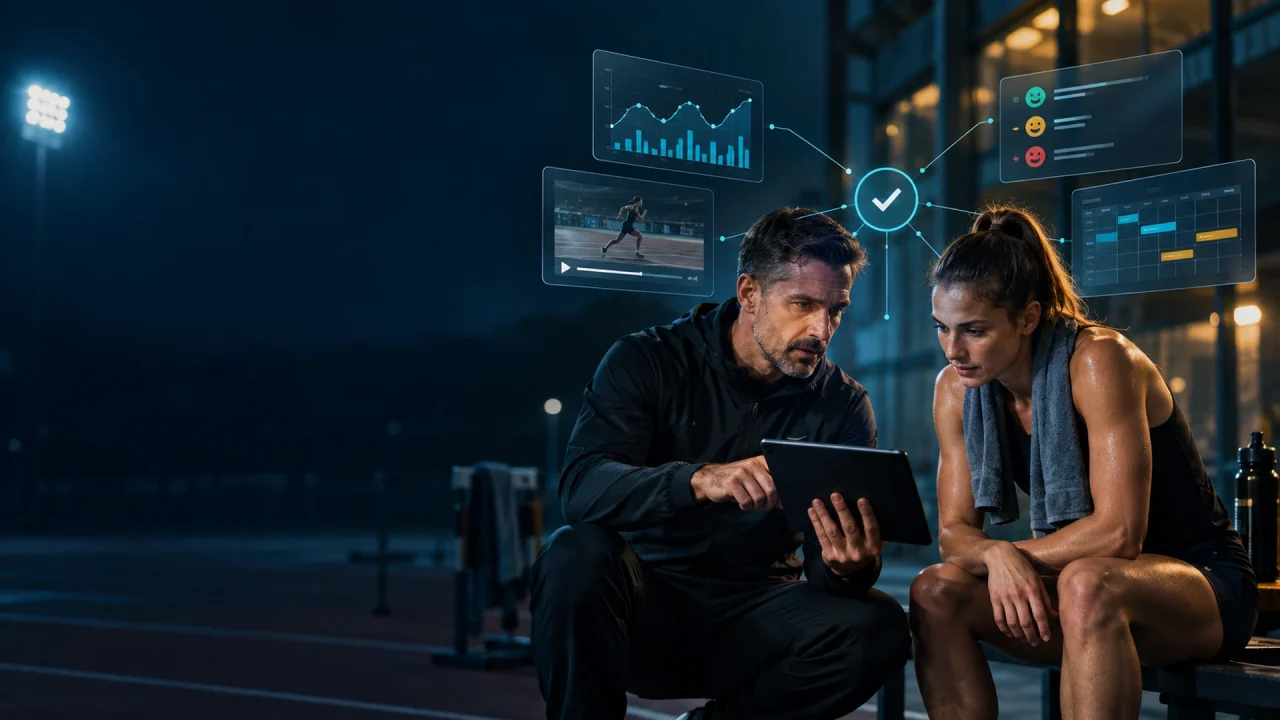
High-performance sport does not have a data problem. It has an interpretation problem, and the two are routinely confused. Add another sensor and you add another column. Add another column and you add another meeting. Somewhere in that sequence the original question gets lost, which is why so many performance departments feel simultaneously over-measured and under-informed.
This is the first of seven articles tracking a specific movement in sports technology: away from isolated measurement and towards connected, coach-led decision support. The editorial position does not change across the series. Artificial intelligence can increase the speed, reach and consistency of analysis. It should expose evidence and uncertainty rather than replace accountable human judgement.
The data-rich, insight-poor performance environment
Ask a head of performance what they are short of and almost nobody says numbers. They say time, agreement and confidence. The morning report exists. What does not exist is the 20 minutes to reconcile it with what the coach saw in the warm-up, what the physiotherapist noted on Friday, and what the athlete said in the car park.
The consequence is not dramatic. It is quiet. Decisions get made on whichever evidence happened to be nearest, and because nothing was written down, the same decision gets re-argued eight weeks later with no memory of the reasoning.
Measurement is not interpretation, and interpretation is not a decision
It helps to separate four things that most dashboards deliberately blur.
- Measurement. The athlete covered a given distance at a given intensity. This is countable and, sensor quality permitting, defensible.
- Interpretation. That load was high relative to this athlete in this phase. This requires context the sensor does not hold.
- Recommendation. Reduce volume today. This is a judgement dressed as an output.
- Decision. We reduced volume today, for these reasons, and this person approved it.
Most products sell you the third and quietly imply the first. The useful engineering question is not whether a model is clever. It is whether a practitioner can tell, at a glance, which of those four things they are looking at.
Where AI genuinely gives a coach time back
The credible near-term value is preparation, not prescription. Assembling the last six weeks of a middle-distance athlete’s availability, session completion, self-reported wellness and competition schedule into one place is tedious, error-prone and takes a skilled person 30 minutes. It is exactly the sort of task a machine should do, and exactly the sort of task that does not require the machine to be right about anything consequential.
September 2025 made the direction plain. World Athletics used its convention in Tokyo to put AI in coaching, talent identification and data analysis on the formal agenda rather than leaving it to vendors, while consumer wearable platforms shipped adaptive coaching, running-tolerance and recovery-informed suggestions to a very large installed base. Those are two different worlds converging on the same behaviour: systems that propose actions rather than merely display history. That makes human oversight more important, not less.
A readiness score should open a conversation, not close one
The single most common failure we see is a composite score treated as a verdict. A number between one and 100 arrives, and the room stops thinking. The experienced coach ignores it, which wastes the investment. The inexperienced coach obeys it, which is worse.
A readiness figure is a prompt to ask three questions. What went into it? How confident is it for this athlete, as opposed to the population it was built on? And what would have to be true for it to be wrong? If the interface cannot answer those, the number is decoration.
Monday morning, one athlete, four sources
Take a hurdler returning from a calf strain. The load record says last week was the highest since March. The wellness questionnaire says sleep has been poor for four nights. The schedule says a trial in 11 days. The coach saw a good, relaxed session on Saturday.
Any one of those, alone, produces a bad decision. Together they produce a specific conversation: is the poor sleep a response to the load, or to the trial? A system that surfaces the four sources with their timestamps and lets the coach record which one they weighted, and why, has earned its place. A system that turns all four into an amber traffic light has removed the only part of the process that had judgement in it.
The minimum standard: provenance, confidence and a named owner
Before a tool goes anywhere near a squad, insist on three things. Provenance: every figure states where it came from and when. Confidence: a well-supported number and a plausible guess are not displayed identically. A named owner: one person recommends, one approves, and those are never the same signature by default.
None of that is expensive. It is a display convention and a habit of writing decisions down on the day they are made. A decision record costs a minute at the time and cannot be reconstructed afterwards at any price.
Where the evidence stops
Adaptive-training and readiness features are decision-support products. Their outputs depend on sensor quality, on modelling assumptions, and on how well an individual resembles the population the model learned from. No score on the market diagnoses fatigue, and none prevents injury. Vendor capability claims, including the ones cited above, describe what a product does rather than proof that it improved anything competitive. Treat them as direction of travel, and validate locally before you rely on them.
The question to take into your next performance meeting
Which five decisions consume the most staff time in a normal week, and for how many of them could you name, today, the person who owns the decision and the evidence they used?
Frequently asked questions
Can AI tell a coach whether an athlete is ready to train?
No, and a product that claims otherwise is overselling. AI can assemble the relevant evidence quickly and consistently, and it can flag that today looks unusual against this athlete’s own history. Whether that means modify, proceed or stop is a judgement that depends on the competition calendar, the athlete’s history and what the coach observed, none of which the sensor holds.
What is the difference between a readiness score and a decision?
A readiness score is a model output. A decision is a recorded choice with a named owner and a stated reason. The score can be an input to the decision. It is not a substitute for one, and treating it as one removes the accountability that makes the decision reviewable later.
Does more data lead to better performance decisions?
Not on its own. Additional inputs improve decisions only when someone has the time and the framework to reconcile them. Without that, more data increases meeting length and disagreement rather than decision quality. The constraint in most programmes is interpretation capacity, not measurement.
Where should a performance programme start with AI?
With the preparation work rather than the recommendations. Automating the assembly of evidence for recurring decisions is low risk, immediately useful and easy to check. Automating the decisions themselves is neither.
What should a coach ask a vendor before buying?
Ask where each number comes from, how confidence is shown, what the model was trained on, how a practitioner corrects an output that is wrong, and what the product does not claim. A supplier who cannot answer the last one clearly is not a supplier you can govern.
About this series
This is the first of seven articles on the movement from isolated measurement to connected, coach-led decision support in high-performance sport. The series follows the Athleet AI cycle of observe, understand, decide, deliver and learn, and is written for coaches, athletes, performance directors, clubs, federations and multidisciplinary squads. Later articles cover the coach as system designer, the athlete context graph, video and physical data convergence, scaling individual attention, natural-language analysis and the governed performance system.
Every club, athlete and scenario used as an illustration in this article is desensitised. Product capabilities are attributed to their vendors and should not be read as independently validated performance benefits. The material is presented to support discussion and further review.