

Paper six of six in the Athleet.AI Working Papers on AI in coaching and athlete development, and the one that asks who decides how this turns out.
Can AI democratise and stratify coaching at the same time?
Yes, and that is the paper’s central claim. Democratisation means a reduction in the difference between the coaching support available to a well-resourced programme and to a volunteer, measured in what actually reaches the athlete. Stratification is the opposite, and it includes the case where everyone improves and the best-resourced improve by more.
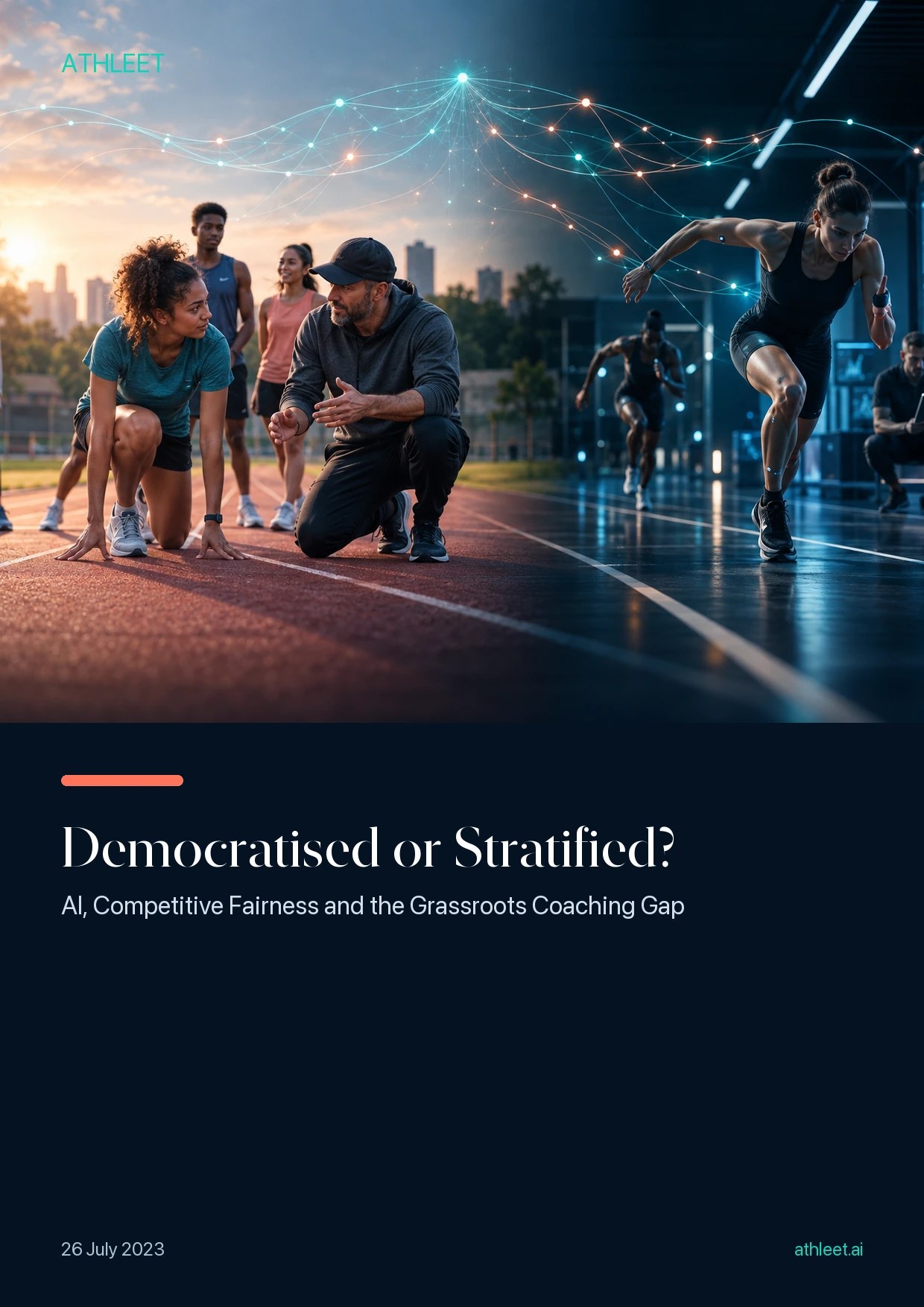
The invented case puts one week side by side. On Monday a national sprint programme’s analyst loads a season of timing-gate, force-plate and wellbeing data into a commissioned model part-trained on the programme’s archive of former athletes. By Wednesday a biomechanist and the relay coach have checked its suggestions against video, discarded two, and adjusted speed endurance work for three athletes returning from minor injuries. On Thursday evening, 40 miles away, a volunteer at a village club types a question into a free chatbot with 14 athletes aged 11 to 15 arriving within the hour, several grown noticeably since Easter. The chatbot returns a tidy, confident plan. It has never met the athletes, cannot see the track, and does not warn that one plyometric drill is a poor choice for a child in a growth spurt. The club’s only qualified coach moved away in the spring.
The elite programme has a biomechanist to catch the unsuitable drill. The volunteer has only her own judgement. An assistant is not a mentor.
What is the case for democratisation?
Two workplace studies of the period, both showing gains falling largest on the least experienced. A preregistered experiment with 453 college-educated professionals found average time down 40 per cent and output quality up 18 per cent, with inequality between workers decreasing. A staggered rollout across 5,179 customer support agents found productivity up 14 per cent on average, greatest for novice and low-skilled workers and minimal for the most experienced, with suggestive evidence that the model was spreading the tacit knowledge of the better agents.
If that pattern transferred to coaching, it would be the most useful thing to happen to grassroots sport in a generation. England’s coaching workforce is overwhelmingly voluntary, with 74 per cent coaching on a voluntary basis, while the 12 per cent working full time deliver 45 per cent of weekly coaching hours. The barriers reported by under-represented coaches are cost of qualifications, absence of mentoring and peer observation, one-off courses with no continuing development, and isolation for those not attached to a club.
Neither study involved coaching, and whether the compression effect carries over is untested. The paper is blunt about this: it found no evidence that AI tools improve coaching outcomes at grassroots level, and nobody who claims to have it.
What is the case for stratification?
Four assets that compound, and that a village club will never hold. Proprietary longitudinal data. The ability to commission or adapt models to that data. Specialist staff who can reject a bad output. Sensor and testing equipment that generates new data to feed the next model.
Fair play scholarship gives this a name. System strength, meaning the financial, technological and scientific resources standing behind an athlete, is already accepted as a fairness problem in sport. A proprietary model trained on a national programme’s archive is system strength. It is neither talent nor effort.
Governing bodies have historically acted late on technology, and AI makes delay more likely because it leaves no physical trace at the competition itself. The transferable precedent is the shoe rules, and specifically the availability provision: a shoe must have been on open retail sale for four months before competition use, and one that is not openly available is a prototype and not permitted. Availability, rather than performance, was the test that made the rule enforceable.
What are the six forms of fairness at stake?
- Representational. Whose athletes are in the data. Tools trained on adult or elite populations may misread girls, late developers and disabled athletes.
- Allocative. Who gets the tools and the support to use them. Access follows money and club size.
- Competitive. Whether athletes have a fair opportunity to perform. Proprietary systems add to system-strength inequality.
- Developmental. Whether the tool serves long-term growth, or nudges towards early selection, specialisation and adult training loads.
- Procedural. Whether an AI-informed decision can be explained and challenged.
- Epistemic. Whose coaching knowledge gets encoded, and therefore whose is quietly displaced.
The sixth is the one that receives least attention and may matter most over a decade. A general chatbot answering a grassroots coach about adolescent athletes is a textbook case of emergent bias, arising from the mismatch between the population a system was built on and the population it is used with.
What should a governing body decide now?
Five choices, and the paper’s expectation is that leaving them to the market produces stratification.
Teach AI use at every licence level, rather than leaving coaches to discover it alone. Offer a shared, governed tool free to licensed coaches, and run an open process, including volunteer coaches, to decide the coaching philosophy it encodes. Set supplier assurance standards covering evidence, model disclosure, notice of material change and continued monitoring, rather than a one-off certificate. Require disclosure of AI systems informing competition decisions. Build or pool technical capability, through a national agency, a shared panel or universities, because no single sport can assess systems it does not own.
One episode from the period explains why continuous monitoring rather than certification is the right instrument. A comparison of two versions of the same commercial models three months apart found one task where accuracy collapsed between March and June, while another model improved on the same task. The specific finding has since been read more sceptically as partly an artefact of evaluation design, and the general point survives intact: the service underneath an approved tool can change without anyone being told.
For a club the practical advice is shorter. Ask your governing body for a lead before adopting whatever arrives first, and insist that any tool comes with a mentor behind it. Deferral in this case is a decision to let the market set the terms.
Free download
Get the full paper
Read Democratised or Stratified? in full, with every claim carrying an evidence grade and the full reference list. Give your name and email and the PDF opens straight away.
Frequently asked questions
Does AI help or harm grassroots coaching?
Both forces operate at once. The question is which dominates, and that depends on institutional choices about coach education, shared tools, supplier standards and disclosure rather than on the technology itself.
Is there evidence AI improves coaching outcomes at grassroots level?
None that the paper could find, and it looked. The productivity evidence comes from writing and customer support, not from coaching, and whether the novice-weighted gains transfer is untested.
Why is the shoe rule a useful precedent?
Because it regulated availability rather than performance. A rule that asks whether a technology is openly available to competitors is enforceable, where a rule asking how much advantage it confers is not.
When does a model become equipment?
The author holds a provisional view loosely, because the boundary between preparation and competition is porous. What he argues for first is disclosure of AI systems informing in-competition decisions, before any availability test is applied.
What should a small club do today?
Recognise that a chatbot plan may be better than what you would have written alone, and that it cannot watch a session, know the athletes or carry responsibility. Seek a person rather than a prompt on questions of loading and growth, and press your governing body for a position.
Legal and regulatory notice. This article describes regulatory developments and governing body positions in general terms. Nothing here constitutes legal advice, and the provision of legal advice sits outside the terms of any engagement with the author or with Athleet.AI. The material is presented to support discussion and further review by qualified advisers.