

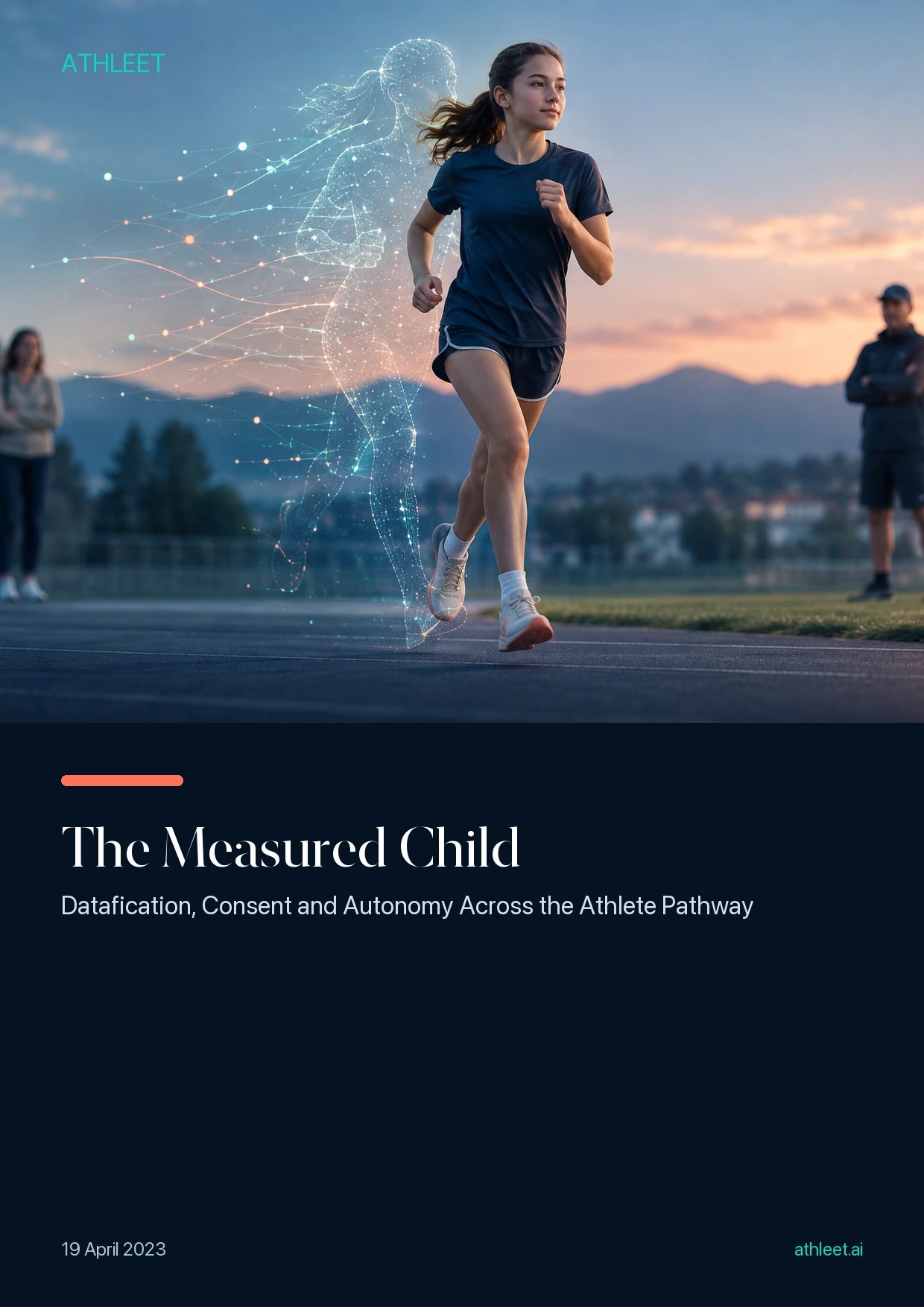
Paper three of six in the Athleet.AI Working Papers on AI in coaching and athlete development, on what a pathway knows about a child and how long it keeps it.
Why does consent fail in a youth pathway?
On two grounds at once. A child cannot give informed consent to uses of their data that nobody present can yet describe, and in a selective programme refusal is never free, because declining measurement carries a cost to selection. A choice with consequences is still a choice, and it should not be described as free.
The paper followed an invented athlete called Maya. Nominated at 12 and screened the week after turning 13: standing and sitting height, body mass, a 20 metre sprint, a jump test, a sleep-and-mood questionnaire, and both parents’ heights for a predicted adult height. Her father signs a clipboard form mentioning performance monitoring, athlete development and research. Over four years the pathway adds tracking loads, a daily wellness app and a subscription analytics tool that produces a maturity-adjusted potential rating and an injury risk flag, both shared with a partner academy when she is released at 16. At 21 she has never seen the rating and does not know that a vendor still holds wellness entries she typed as a tired 14-year-old.
Nobody in that sequence acts in bad faith. That is the point of telling it that way.
What changes when AI enters the picture?
Raw measurements become inferences, and inferences are a different kind of thing. The paper separates three categories and tracks how each behaves.
- Measured data, such as a sprint time, height or mass. Visible to the athlete, and it ages quickly.
- Derived data, such as load ratios or growth rate. It needs the method to interpret it, and it is reused moderately.
- Inferred data, such as maturity status, an injury flag or a potential rating. It is rarely shown to the athlete, and it travels furthest.
Measurements describe a child. Inferences make claims about who that child will become. They are also more consequential, less visible and, as scholarship on the point has argued, less protected than the data they were drawn from. The maturity estimates that feed them carry errors that are largest for the early and late maturers whose classification matters most.
The usual fallback of anonymisation does not rescue this. Re-identification research found that 15 demographic attributes were enough to identify the overwhelming majority of a population. A regional squad of 20 teenagers with public ages, events, clubs and results is not a hard case.
What should a pathway commit to instead?
Four things, none of which depends on getting a better signature.
- Collect only what a named coaching or safeguarding purpose requires, with that purpose recorded against each item at the point of collection.
- Hold inferred data apart, restrict access to it, and never share it externally without a fresh and specific decision.
- Set retention periods that actually end, with inferred data held shortest.
- Give every athlete measured before 18 a formal review at adulthood.
The review at 18 runs in six steps: purpose recorded at collection, inferences held apart, expiry by default, notice at 18, review and withdraw, confirm and close. In the paper’s second scenario it works. A month after turning 18, Sam receives a plain-language summary listing the measurements held, two maturity estimates, a potential rating and the partner academy that received it. Sam deletes the rating and the wellness entries, and lets the sprint times stand for two more years for coach education.
The practical objections are conceded rather than waved away. Contact details go stale, athletes ignore the message, and records have been shared with organisations the pathway cannot compel. None of that is a reason to hold a 13-year-old’s inferred potential rating indefinitely.
Where does the existing framework already point this way?
Data protection law treats children as meriting specific protection, defines profiling as automated evaluation predicting performance, health, reliability or behaviour, and requires data minimisation and storage limitation. It is also explicit that erasure matters particularly where consent was given as a child and that the right is exercisable in adulthood, which is the hook the review at 18 hangs on.
The children’s design code in the UK sets 15 standards including the best interests of the child, data minimisation, and profiling off by default. International guidance on AI and children adds further requirements. What none of it does is speak directly to a talent pathway, which is why the paper puts the obligation on governing bodies rather than waiting.
A governing body’s first two jobs are an inventory and then contracts. The inventory lists every system holding data on under-18s, the categories each holds, which of them produce inferences, and who receives those inferences. Contracts are negotiated once for the whole sport, including onward deletion, because no individual club has the leverage to negotiate them alone.
What should a coach and a parent do differently?
A coach should record a named purpose against each item collected and stop presenting the consent form as a ticket to participation. Where a measure is a requirement, say so plainly rather than describing it as optional. A vendor’s potential rating should never be treated as having the same standing as a sprint time.
A parent should understand that the signature authorises uses nobody present can describe, that the inferences drawn later are the real exposure, and that hesitating is noticed in a small programme. Expect to be consulted again whenever a new tool arrives, rather than once at the start.
The paper’s own framing is the most useful thing in it. A decision made by a coach about what to store is a decision about what a 25-year-old will find, and a child measured at 13 may still be carrying that measurement, in altered and enlarged form, at 21.
Free download
Get the full paper
Read The Measured Child in full, with every claim carrying an evidence grade and the full reference list. Give your name and email and the PDF opens straight away.
Frequently asked questions
Is a signed parental consent form enough?
It is necessary and it is not sufficient. It cannot cover uses that did not exist when it was signed, and in a selective programme it is given under pressure that the form does not acknowledge. The protections that work are structural: collect less, hold inferences apart, and let retention expire.
What is inferred data and why treat it separately?
Anything the system concludes rather than measures, such as maturity status, an injury flag or a potential rating. It is rarely shown to the athlete, it travels furthest between organisations, and it makes claims about the future rather than recording the past.
What is the review at 18?
A plain-language summary sent to every athlete measured before adulthood, listing what is held, what was inferred and who received it, with a straightforward route to delete any of it. It is the practical expression of a right that already exists and is almost never exercised.
Does anonymising the data solve this?
Not in squads of this size. Re-identification is straightforward where ages, events, clubs and results are already public, which they generally are in youth sport.
Who should hold youth athlete data?
The paper leaves this open, and lists the candidates: the club, the governing body, or a trusted third party with no interest in selection. It is one of the questions it says it cannot answer from published evidence.
Legal and regulatory notice. This article describes data protection and safeguarding obligations in general terms. Nothing here constitutes legal advice, and the provision of legal advice sits outside the terms of any engagement with the author or with Athleet.AI. The material is presented to support discussion and further review by qualified advisers. Every club and pathway should take its own advice on its specific circumstances.