
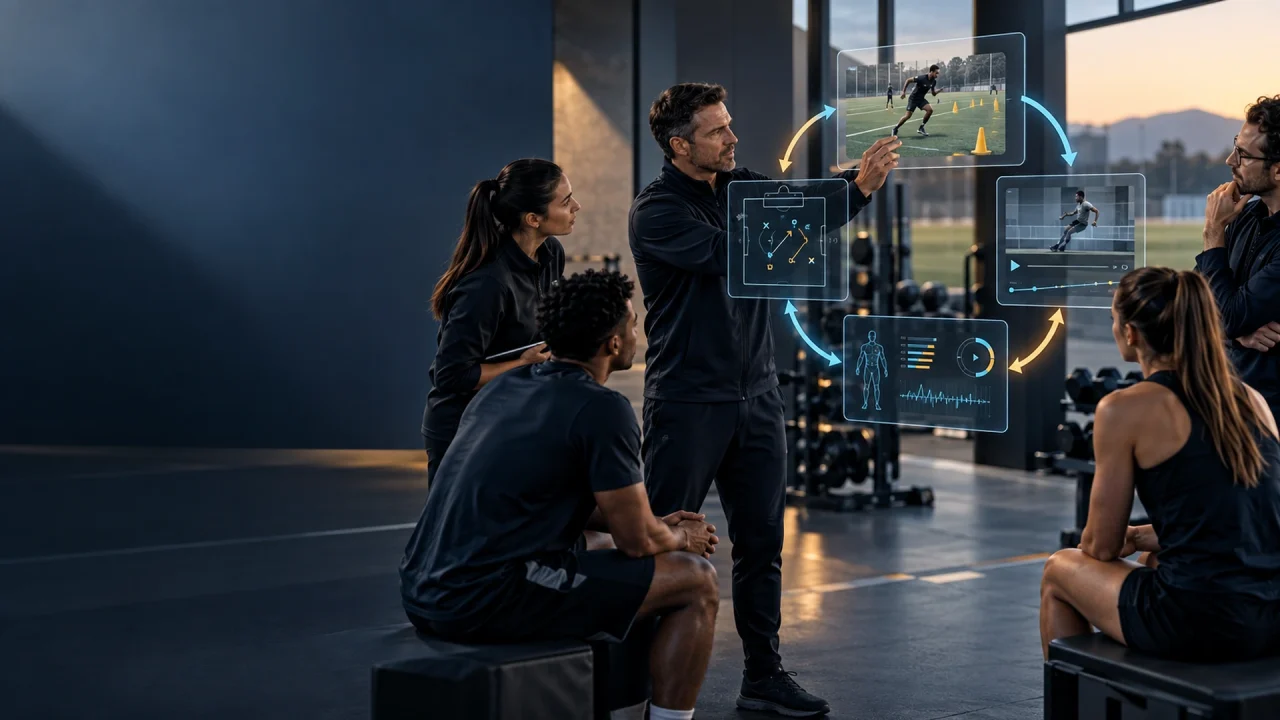
Adding a dashboard almost never changes behaviour. Most performance departments have proved this to themselves at least twice. A new platform arrives, the reporting improves, everyone agrees the visualisations are excellent, and eight weeks later the same five decisions are being made the same way by the same people on the same evidence they were using before.
The reason is not laziness and it is not resistance to technology. It is that the decision environment was never redesigned. The tool was added to a workflow that already had its own habits, authorities and silences, and workflows win.
Why another dashboard rarely changes anything
A dashboard answers questions it was built to answer. The questions that actually consume a coaching week are messier: should this athlete travel, who takes the call if the physiotherapist and the coach disagree, and what do we do differently because of what happened in March?
None of those are display problems. They are design problems, and the person best placed to solve them is the coach, because they are the only one who holds the methodology the system is supposed to serve.
The coach as designer of questions, thresholds and escalation
This is the shift the article title points at. As athlete-management systems absorb AI, the coach’s job expands from interpreting reports to specifying the environment in which reports mean something. In practice that means writing down four things that are usually left implicit.
- The questions. The eight to 12 recurring decisions the system exists to support, in the coach’s own words rather than the vendor’s.
- The evidence. Which inputs are trusted for each question, and which are context rather than proof.
- The thresholds. What level of change is worth a conversation, distinguished clearly from what is worth an intervention.
- The escalation. Who is told, who decides and who can overrule, before the situation arises rather than during it.
None of this requires technical skill. All of it requires a coach willing to make their reasoning explicit, which is a harder ask and a more valuable one.
Turning a coaching philosophy into an approved knowledge environment
Every experienced coach has a philosophy. Very few have it written down in a form a system can act on. That gap is where AI tools tend to substitute their own defaults, which is how a squad ends up unknowingly coached by a vendor’s assumptions about training load.
The remedy is unglamorous. Document the progressions you actually use, the constraints you will not breach, the language you want used with athletes, and the evidence you consider settled. That becomes the approved knowledge the system draws on, and it is the difference between technology conforming to a methodology and dictating one.
Connecting video, load, plans, athlete feedback and medical restriction
The 2025 and 2026 athlete-management conversation moved steadily towards integration. Teamworks has argued publicly for AI-supported, joined-up athlete management, and Catapult’s Vector 8 launch described faster uploads, live sport-specific data and direct integration between athlete monitoring and its video suite. Both are vendor accounts of their own products. What they usefully illustrate is a direction: fewer disconnected tools, and shared review that happens in hours rather than days.
Integration matters for a reason that has nothing to do with convenience. When load, video, plan, athlete report and medical restriction sit in five places, the person who assembles them controls the interpretation, usually without meaning to. When they sit together, disagreement becomes visible, which is uncomfortable and correct.
Designing the multidisciplinary meeting
The performance meeting is where system design either pays off or collapses. Three habits make the difference.
Start from the decision, not the department. A meeting that runs through sports science, then medical, then coaching, produces three monologues. A meeting that takes each pending decision in turn and asks each discipline to speak to it produces an argument, which is the point.
Make disagreement a recorded output rather than a failure. If the analyst and the coach read the same session differently, that is information about the evidence, and it should survive the meeting.
Close every item with a named owner and a review date. An unowned decision is a decision nobody will learn from.
Capturing rationale so the system learns without rewriting history
Here is the discipline that separates a programme that improves from one that merely accumulates. Record why, on the day, in one or two sentences, alongside what. Then leave it alone.
The temptation after a bad outcome is to tidy the record. Resist it. The value of a decision log is that it preserves what was known at the time, which is the only fair basis on which to judge a decision. Institutional knowledge that survives a change of staff is built this way, and it cannot be reconstructed retrospectively at any price.
Where the evidence stops
An integrated workflow is not automatically an intelligent one, and this is the failure mode we see most often after a platform migration. A single interface can create a false impression of a single validated source. In practice it is frequently summarising vendor-generated metrics whose derivation is undisclosed, alongside genuinely measured values, in identical typography. Require validation of each input separately, and make the interface state which is which. The product claims cited above describe capability, not independently verified performance benefit.
The question to take into your next performance meeting
If your head coach left in six weeks, how much of the reasoning behind this season’s decisions would leave with them?
Frequently asked questions
What does it mean for a coach to be a system designer?
It means specifying the decision environment rather than only interpreting its outputs: which recurring questions the system supports, which evidence is trusted for each, what change is significant enough to act on, and who holds authority when disciplines disagree. It is a design role, not a technical one, and it belongs with the person who owns the methodology.
Do integrated athlete-management platforms improve performance?
There is good reason to think integration reduces delay and disagreement about facts. There is much weaker evidence that any specific platform improves competitive outcomes, and vendors rarely claim that directly. Judge a platform on whether it shortens the path from question to decision in your programme, and validate that locally.
How do you stop technology from dictating coaching methodology?
By writing the methodology down before configuring the tool. If the progressions, constraints and language you use are not documented, the software’s defaults will fill the gap, and a squad can end up following a vendor’s assumptions without anyone choosing them.
Why record the reasoning behind a decision and not just the decision?
Because a decision without its reasoning cannot be reviewed fairly. Outcomes are noisy in sport, and judging a choice by its result rewards luck. A one-sentence rationale, written on the day, lets a programme learn from a season rather than merely remember it, and it survives staff turnover.
Who should own a performance decision when specialists disagree?
One named person, decided in advance and by decision type rather than by seniority. Health-related decisions sit with the qualified clinician. Selection and training design sit with the coach. What matters most is that the answer exists before the disagreement, and that the dissent is recorded rather than smoothed away.
About this series
This is the second of seven articles on the movement from isolated measurement to connected, coach-led decision support in high-performance sport, following the Athleet AI cycle of observe, understand, decide, deliver and learn. The first looked at why more data does not produce better decisions. The next examines the athlete context graph, and why personalisation requires a longitudinal model rather than a population average.
Every club, athlete and scenario used as an illustration in this article is desensitised. Product capabilities are attributed to their vendors and should not be read as independently validated performance benefits. The material is presented to support discussion and further review.