

Football’s talent problem is not finding the best player in Saturday’s match. It is that the system for recognising potential is narrow, biased in ways it can name, and almost entirely without memory. Players are seen once, judged against children who are a year older or a year further into puberty, and then either signed or forgotten, with no record surviving either decision.
Football believes it has the widest talent net in world sport. It watches more children, in more countries, more often, than any other game. The evidence assembled in this paper suggests something less comfortable, which is that the net is wide and also full of holes cut in a very particular shape.
Key findings at a glance
- Early success predicts remarkably little. Across 189 study samples, 89.2 per cent of internationally ranked under-17 and under-18 athletes never reach international level as seniors. Junior performance explains around 2.2 per cent of the variance in senior performance.
- Maturity bias is larger than the relative age effect and grows with age. Across 12 academies and 1,011 players, maturity selection bias reached a very large effect by under-18. In one national pathway, no late-maturing player appeared in the under-15 or under-16 international squads at all.
- Birth month remains a powerful filter that washes out later. Players born in the first quarter made up 43 to 46 per cent of European national youth squads against 9 to 18 per cent born in the last, and yet early-born professionals are no better valued in the transfer market.
- Scouts watching the same children do not agree. When 83 scouts rated the same 24 under-11 players, inter-rater reliability coefficients ran between 0.02 and 0.09. Scouts also report believing they can judge adult potential from around the age of 13 and a half.
- Selection often rewards physical maturity rather than football. In a four-year study of Dutch players aged eight to 12, sprint speed over 30 metres was the strongest single predictor of academy selection.
- The AI research in this area is not ready to be sold. No systematic review of machine learning applied to talent identification in football had been published when this paper was written. The nearest critical review concludes that the scope and usefulness of these methods remain relatively unknown.
The pathway’s hidden filters
Birth month cuts one hole. Biological maturity cuts a much bigger one. Where a child lives cuts another, and so does what a family can afford in petrol and Saturday mornings. None of these has anything to do with football ability, and all of them operate before anybody has watched a player for a second time.
The maturity filter is the one clubs consistently underestimate. It is larger than the relative age effect, it grows rather than shrinks with age, and in at least one national pathway it had excluded late-maturing players from under-15 and under-16 international squads entirely.
Capacity and memory rather than prediction
The honest opportunity is not a model that spots the next signing. It is a system that helps people observe more players, record what they saw in a usable form, hold the context that makes a comparison fair, and prompt somebody to look again.
That last point carries most of the value. The current system has almost no memory of the players it did not take. A player deselected at 12 for being small generates no record that anybody revisits at 15, by which time the reason for the deselection has usually disappeared.
What should be refused
No score attached to a child. No ranking. No prediction of adult potential. No system that communicates with a child without an adult in the loop. And no model trained on a club’s own past selections, because such a model learns the club’s history rather than the game, then recommends the same biases back with a decimal point attached.
What follows for a club, an academy or an association
The recommendation is cheaper and slower than the technology allows. Record observations properly, with the date, the observer and the context. Record birth month and maturity band alongside every judgement so that a comparison can be made fair. Keep the record when a player is not taken, and build a routine that looks at it again.
None of this requires a model, and all of it removes bias that is currently invisible.
Free download
Get the full paper
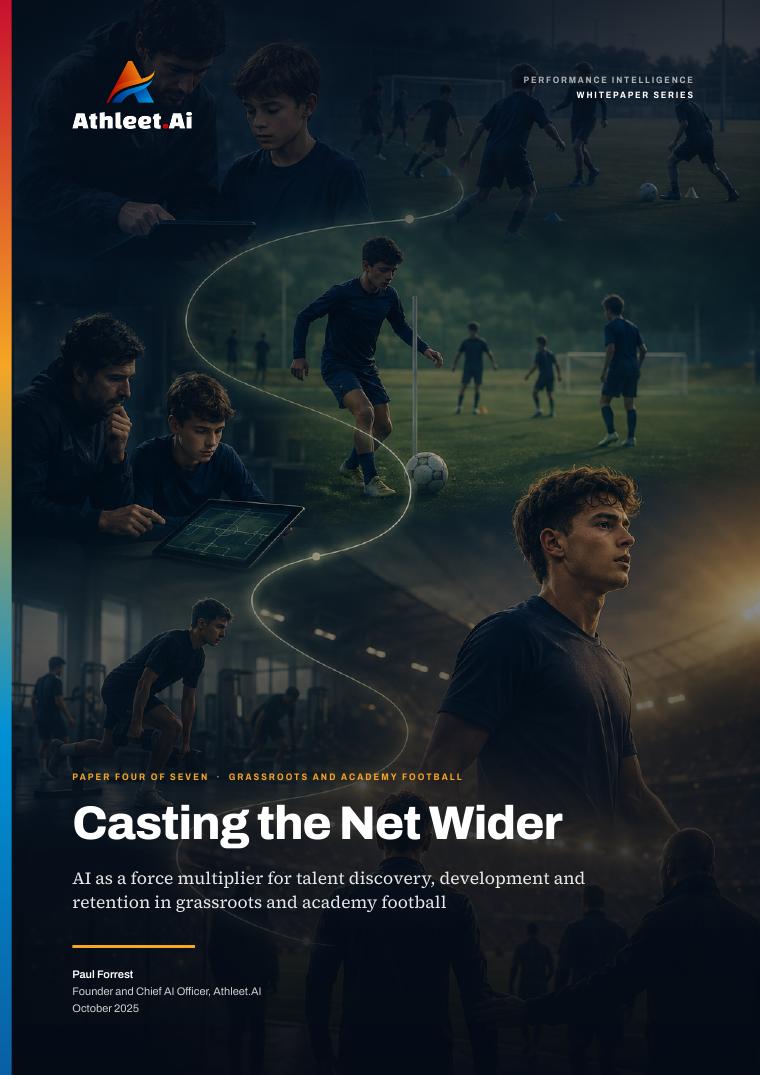
Read Casting the Net Wider in full, with every claim carrying an evidence grade and the full reference list. Give your name and email and the PDF opens straight away.
Frequently asked questions
Can AI identify future football talent in children?
Not on the current evidence, and the attempt is actively harmful. Across 189 study samples, 89.2 per cent of internationally ranked under-17 and under-18 athletes never reached international level as seniors, and junior performance explains around 2.2 per cent of the variance in senior performance. No systematic review of machine learning applied to talent identification in football had been published when this paper was written. A model trained on a club’s past selections learns the club’s biases rather than the game.
What is the relative age effect in football?
It is the over-representation of children born early in the selection year. Players born in the first quarter made up 43 to 46 per cent of European national youth squads, against 9 to 18 per cent born in the last quarter. The advantage does not persist into professional value, as early-born professionals are no better valued in the transfer market, which means the pathway is filtering on something that stops mattering.
Is maturity bias worse than the relative age effect?
Yes, and it grows with age rather than fading. Across 12 academies and 1,011 players, maturity selection bias reached a very large effect by under-18. In one national pathway, no late-maturing player appeared in the under-15 or under-16 international squads at all. Relative age is a matter of months, while biological maturity can differ by years between children of the same birth date.
How consistent are scouts when judging young players?
Far less consistent than the confidence placed in their judgements. When 83 scouts rated the same 24 under-11 players, inter-rater reliability coefficients ran between 0.02 and 0.09, which is close to no agreement at all. Scouts nonetheless report believing they can judge adult potential from around the age of 13 and a half.
What should an academy record about every player it watches?
The date, the observer, the context of the observation, the player’s birth month and their maturity band. Recording those alongside the judgement is what makes a later comparison fair. Keeping the record for players who were not taken, and building a routine to revisit it, is the single cheapest improvement available to most academies.
About this series
This is the fourth of seven papers on the responsible use of artificial intelligence in performance sport, and the one that concerns children most directly. The governance framework sits in The Responsible Performance System, and the elite football counterpart is The Augmented Touchline. The series also covers elite athletics, grassroots athletics, triathlon and golf.
Legal, regulatory and safeguarding notice. This article and the paper it summarises describe data protection law, regulator guidance and safeguarding standards. Nothing here constitutes legal advice, and the provision of legal advice sits outside the terms of any engagement with the author or with Athleet.AI. The material is presented to support discussion and further review by qualified advisers, and nothing here replaces a club’s obligations under its governing body’s safeguarding policy. Every club, player and scout used as an illustration is synthetic.