
Grassroots athletics is limited by coaching capacity rather than by information. A club with 120 members and eight active coaches cannot individualise, cannot review every athlete, and cannot afford the specialist support that professional sport takes for granted. The coaches carrying that load are also, in most cases, doing it for nothing, in the evenings, around work.
Community athletics does not have a data problem. Most clubs could not fill a spreadsheet if they wanted to, and would be right not to try. What clubs have is a capacity problem, an administration problem and a knowledge-access problem, all of which land on the same small group of people.
Key findings at a glance
- The workforce is under strain and changing shape. Around 3.1 million people coached somewhere in the United Kingdom in the year to mid-2024, and the share coaching only as volunteers fell to 33 per cent, from 40 per cent in 2022 and 46 per cent in 2019. Sport volunteering in England remains 1.7 million people below its 2016 level.
- Cost and time are the barriers, and both are addressable. A third of coaches cite the cost of qualifications and a third cite balancing work and home life. Administration is the part of the load most amenable to help, and it is the part nobody entered coaching to do.
- Early selection is close to worthless, and expensive. Junior performance explains around two per cent of the reliable variance in senior performance. In French athletics data, being a year older within the selection year was worth 6.5 per cent in under-13 boys’ 100m times, falling to 1.9 per cent by under-17.
- Maturity estimates carry more error than clubs realise. The most widely used non-invasive equation showed longitudinal stability in fewer than 45 per cent of players and overestimated age at peak height velocity by up to 0.9 years, with the error running in opposite directions for earlier and later maturers.
- The sport loses teenage girls in large numbers, for reasons it can name. Some 43 per cent of girls who saw themselves as sporty at primary school disengage as teenagers, against 24 per cent of boys, and enjoyment of physical education falls from 86 to 56 per cent across the same age range.
- Children’s data raises the bar, and the bar is public. The Children’s Code sets 15 standards for services likely to be accessed by under-18s, and Article 35 of the UK GDPR requires a data protection impact assessment before, not after, any high-risk processing begins.
What AI can genuinely do for a volunteer coach
The honest list is shorter than the marketing and more useful than the scepticism allows. Assistance can draft, differentiate, remember, communicate and prompt reflection. It can turn one session plan into three ability variants. It can hold what happened last Thursday so that a coach seeing 30 athletes for 90 minutes a week does not have to. It can draft the message to parents that would otherwise be written at 11 o’clock at night.
Each of those releases coaching attention for the part only a person can do, which is watching an athlete move and deciding what to say to them.
What must be refused outright
The paper draws a boundary deliberately tighter than the law requires, and repeats it twice, because a volunteer welfare officer should not have to adjudicate a borderline case at nine o’clock on a Thursday.
- Nothing that selects or ranks a child.
- Nothing that interprets pain or reports on health, body composition or maturity.
- Nothing that communicates directly with a child without an adult in the loop.
Those are not edge cases in youth sport. They are the first four things a technology proposal usually offers.
Why early selection costs a club more than it gains
Selection at under-13 largely measures birth month and puberty. The French athletics data puts a number on it: being a year older within the selection year was worth 6.5 per cent in under-13 boys’ 100m times. That advantage decays to 1.9 per cent by under-17, by which point the athletes who were on the wrong side of it have mostly left.
Maturity adjustment is the obvious answer and it is less reliable than clubs assume. The most widely used non-invasive equation was longitudinally stable in fewer than 45 per cent of players and mis-estimated age at peak height velocity by up to 0.9 years, with the error running in opposite directions for early and late maturers. A club correcting for maturity with that equation may be adding error rather than removing it.
What follows for a club or an association
The recommendation is cheaper and slower than most technology proposals. Begin by writing down what you already do. A club whose session plans, consent records and membership list live in one place has taken the largest single step available to it, and has spent nothing.
Introduce assistance where the consequence of an error is low and the time saved is real, meaning session drafting, differentiation, communication and record-keeping. The paper proposes a regional cohort pilot rather than a product rollout, measuring coach time, retention and coach confidence, and keeping an honest count of the prompts coaches found useless.
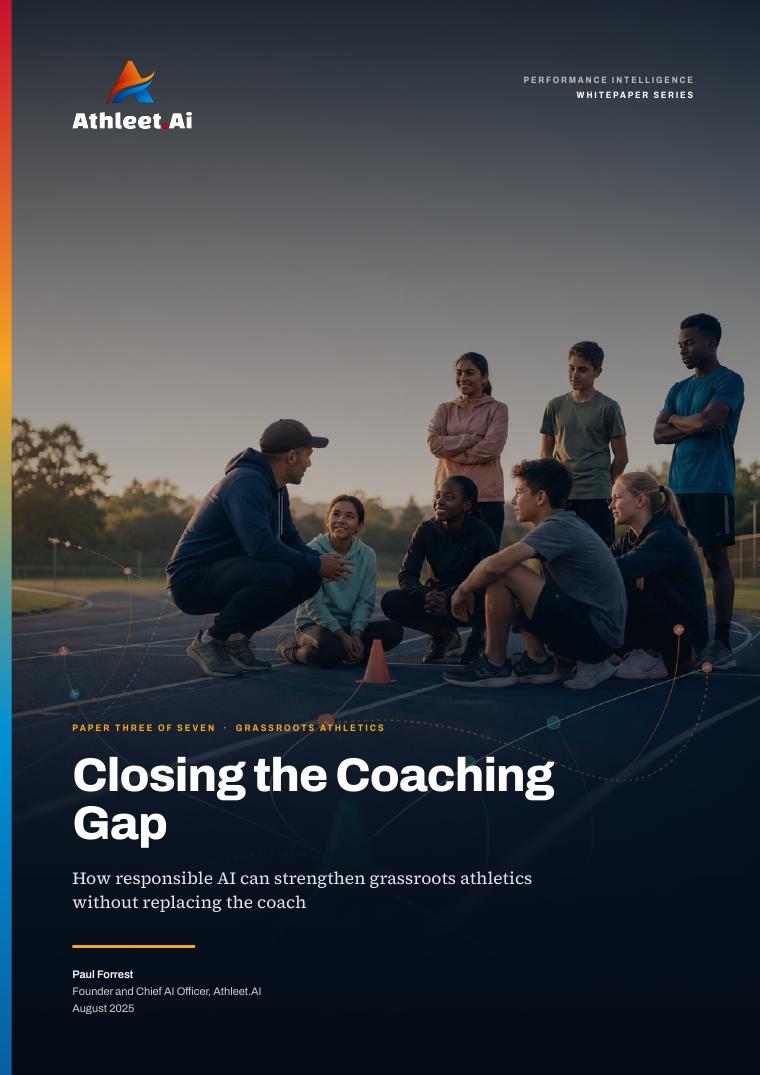
Free download
Get the full paper
Read Closing the Coaching Gap in full, with every claim carrying an evidence grade and the full reference list. Give your name and email and the PDF opens straight away.
Frequently asked questions
Can AI help a volunteer athletics coach?
Yes, in a narrower way than most products claim. The useful contributions are drafting sessions, differentiating one plan across mixed abilities, remembering what happened at previous sessions, drafting communication to parents and athletes, and prompting a coach to reflect. All of those are administrative rather than analytical, and administration is the part of the coaching load nobody entered the sport to do.
Should AI be used to select or rank young athletes?
No. Junior performance explains around two per cent of the reliable variance in senior performance, so the underlying signal barely exists. Selection at younger ages largely measures birth month and biological maturity rather than ability. A system that scores or ranks a child gives a spurious precision to a judgement the evidence does not support, and it creates a record that follows the child.
Is it legal to process children’s data in a sports club?
It is lawful with the right basis and the right safeguards, and the bar is higher than for adults. The Children’s Code sets 15 standards for services likely to be accessed by under-18s, and Article 35 of the UK GDPR requires a data protection impact assessment before high-risk processing begins rather than after. Nothing here is legal advice, and a club should take its own, alongside its governing body’s safeguarding policy.
How reliable are biological maturity estimates in youth sport?
Less reliable than their widespread use implies. The most commonly used non-invasive equation showed longitudinal stability in fewer than 45 per cent of players and overestimated age at peak height velocity by up to 0.9 years, with errors running in opposite directions for earlier and later maturers. Using it to adjust selection can add error rather than remove it.
Why do teenage girls leave athletics, and can technology help?
Some 43 per cent of girls who saw themselves as sporty at primary school disengage as teenagers, against 24 per cent of boys, and enjoyment of physical education falls from 86 to 56 per cent across that age range. The causes are social and structural rather than informational, so technology helps only indirectly, by giving coaches back the time to notice and respond to individuals.
About this series
This is the third of seven papers on the responsible use of artificial intelligence in performance sport, and the only one written for people who are not paid to do the work they do. The governance framework sits in The Responsible Performance System, and the elite counterpart is The Intelligent Track. The series also covers grassroots and academy football, triathlon, elite football and golf.
Legal, regulatory and safeguarding notice. This article and the paper it summarises describe data protection law, regulator guidance and safeguarding standards. Nothing here constitutes legal advice, and the provision of legal advice sits outside the terms of any engagement with the author or with Athleet.AI. The material is presented to support discussion and further review by qualified advisers, and nothing here replaces a club’s obligations under its governing body’s safeguarding policy. Every club, coach and athlete used as an illustration is synthetic.